One week you’re done, the next you’re back in their arms, crying with relief after a blowup. The highs feel huge, the makeups feel like proof, yet the doubt never really leaves. If that sounds familiar, you might be caught in a trauma bond in a toxic relationship, and it can look a lot like love from the inside.
This post gives you a simple checklist to tell the difference between trauma bond vs real love, especially when emotional abuse or relationship abuse is in the mix. It’s not about labeling your partner as a narcissist, or proving anything in a debate. It’s about spotting patterns, trusting your body, and protecting your well-being so recovery and relationship healing towards true love can actually start.
Printable quick checklist (most of the time, not just on good days):
- I have secure attachment and feel mostly calm and safe, not anxious and “on watch.”
- Conflict leads to repair and change, not fear, blame, or punishment.
- I can set boundaries without payback (silent treatment, threats, guilt).
- Love feels steady, not like relief after pain.
- I don’t have to shrink, perform, or “earn” basic kindness.
Safety note: If someone monitors your device, use a safer device if you can, or private browsing. Don’t change settings or delete history if it could put you at risk.
This is educational, not professional advice. If you’re in danger, contact local emergency services, or get confidential support: https://www.thehotline.org/resources/trauma-bonds-what-are-they-and-how-can-we-overcome-them/ , https://www.apa.org/topics/violence/intimate-partner-violence , https://www.nhs.uk/live-well/getting-help-for-domestic-violence/ .
Trauma bond vs real love, plain-language definitions that actually help
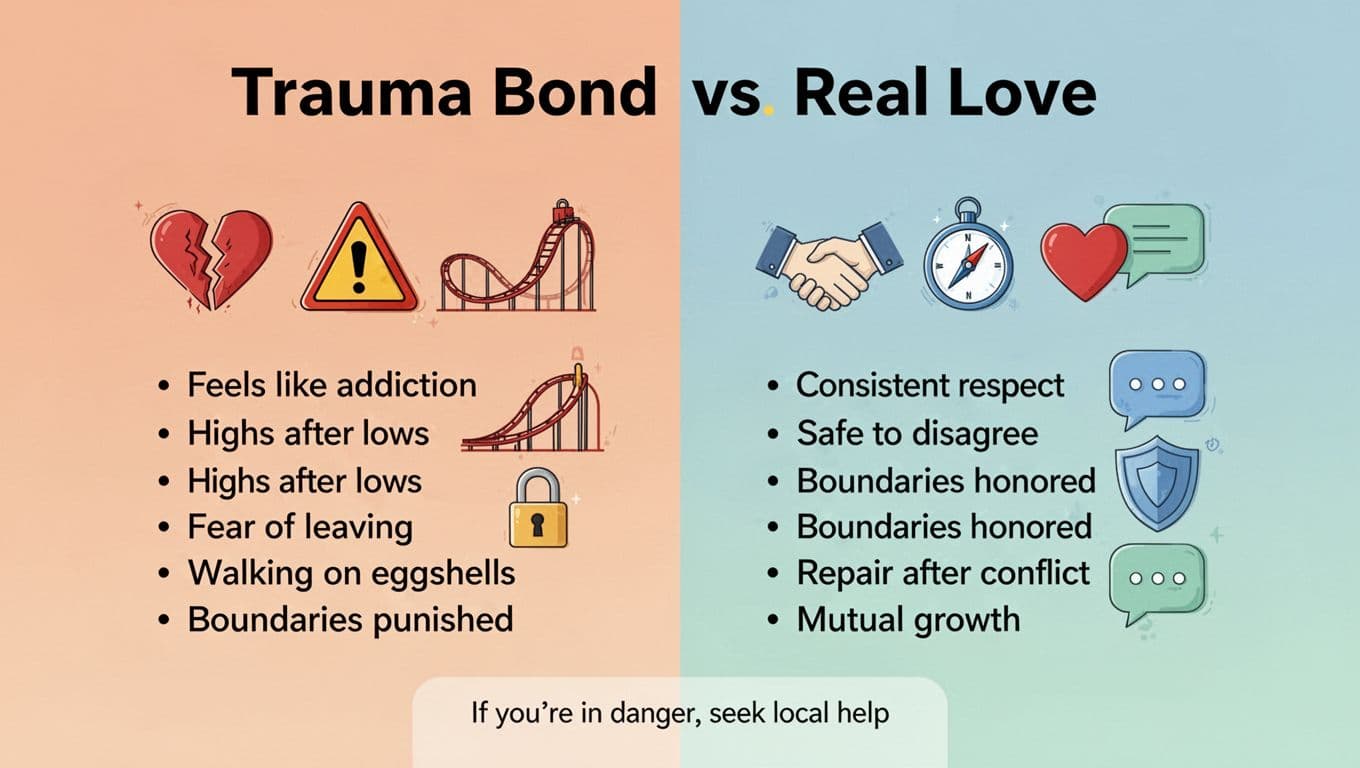
Here’s the simplest way to tell the difference.
A trauma bond is an attachment that gets stronger because of a cycle: hurt, fear, then relief. The relationship feels intense because your body keeps bracing for what comes next, then crashing into “finally, it’s okay” when things calm down.
Real love is an attachment that gets stronger because of trust: care, respect, and repair that actually lasts. It can feel quieter, but it also feels safer. A trauma bond thrives on unpredictability, while real love builds on reliability.
If you want a quick snapshot you can screenshot, this table covers the core difference:
| If you’re asking… | More like a trauma bond | More like real love |
|---|---|---|
| “What keeps me here?” | Fear, guilt, obligation, relief after harm | Choice, respect, steady care |
| “How do I act day to day?” | Hypervigilant, performing, self-silencing | More yourself, more honest, more relaxed |
| “What happens after conflict?” | Apologies, promises, then repeated harm | Accountability, changed behavior, consistent repair |
If love feels like a test you can fail at any moment, it’s not emotional safety. It’s survival mode.
What a trauma bond often looks like in real life
 Photo by cottonbro studio
A trauma bond usually doesn’t start with obvious cruelty. It often starts with love bombing, connection, charm, chemistry, or a feeling of being “chosen.” Then the rules change, and you start adapting to keep the peace.
One common sign is walking on eggshells. You scan their tone, their face, even the way they shut a door. You plan your words like you’re trying to disarm a bomb. Over time, that constant monitoring can look like devotion from the outside, but inside it feels like stress.
Another pattern is needing approval to feel okay. You might notice you can’t relax until you know they aren’t mad. When they praise you, you feel high. When they pull back, your stomach drops. That isn’t you being “too sensitive.” That is your nervous system learning that connection can be taken away.
Trauma bonds also feed on guilt and obligation. You stay because you feel responsible for their pain, their past, their reactions, their bills, their loneliness. In relationship abuse, guilt often gets used like a leash. The message becomes: “If you leave, you’re the villain.”
Isolation can creep in quietly. You might cancel plans to avoid jealousy, conflict, or punishment. You might stop sharing details with friends because it feels embarrassing, or because your partner says they are “a bad influence.” Over time, your world gets smaller, which makes leaving feel impossible.
Jealousy is another big one, especially when it’s framed as love. It can sound like, “I just care so much,” or “I can’t lose you.” Yet it shows up as control, suspicion, and accusations. That’s not protection. That’s possession.
The push-pull cycle of abuse often seals the trauma bond. It looks like:
- A blowup, coldness, or threat of breakup.
- A painful distance where you panic and try harder.
- A sudden “makeup” phase with affection, sex, gifts, or big promises.
- A short calm, then the next trigger.
Apologies can be part of this cycle, but they are often followed by the same harm. You might hear the perfect words, then watch the same behavior return. That whiplash can keep you stuck, because you keep hoping the “good version” will stay.
In emotional abuse (and sometimes dynamics linked with narcissism), you may also notice gaslighting, minimizing and self-blame. You downplay what happened because it seems easier than facing it. You tell yourself, “It wasn’t that bad,” or “I caused it.” If you’re curious about how harm can hide in plain sight, this breakdown of emotional neglect vs emotional abuse can help you name what’s been happening.
The hardest part is the feeling that you cannot leave. Not because you don’t see the problem, but because leaving feels like losing oxygen. That trapped feeling is a hallmark of a trauma bond, not proof that it’s love.
What real love looks like when no one is performing
Real love is not perfect. People still get annoyed, have baggage, and miss the mark. The difference is what happens next, and what the relationship feels like most days.
Start with consistent respect built on mutual respect. Respect shows up in tone, timing, and restraint. It means they don’t punish you for having needs. It also means you don’t punish them for having needs. There’s a steady baseline of kindness, even during stress.
Healthy love also includes open communication without mind games. You don’t have to decode sarcasm, guess what you did wrong, or chase them for basic clarity. When something is off, it gets named. When you ask a question, you get a real answer. This fosters an authentic connection over time.
Boundaries matter here, and not just in theory. In real love, boundaries are honored. Your “no” might disappoint them, but it doesn’t trigger payback. You can ask for space, privacy, or a slower pace without being accused of betrayal.
Disagreements happen, but they don’t come with threats. In a safer relationship:
- You can disagree without fear of abandonment.
- Nobody uses yelling, silent treatment, or humiliation as a weapon.
- You don’t have to “win” to be treated well.
Repair is another tell. A real repair attempt includes changed behavior, not just emotion. Tears, gifts, and long speeches can feel powerful, but they are not the same as accountability. In real love, you see follow-through. The pattern shifts because the person does the work.
You also get freedom to be yourself. Your hobbies don’t get mocked. Your feelings don’t get twisted into “proof” that you are unstable. Your wins don’t get treated like competition. You can relax into your own personality again.
Support looks concrete, too. A loving partner supports your goals, celebrates growth, and respects your time. They also make room for your people. You have space for friends, family, and community, because love doesn’t need isolation to survive.
Most importantly, real love has mutuality and emotional safety. You both matter. You both get to have needs. You both get to feel safe in your own home and body. If you want a clinical overview of the difference, this trauma bond vs love guide from Charlie Health lays out common patterns in clear language.
Why your body can feel hooked even when your mind knows it is wrong
If you’ve ever thought, “I know this is unhealthy, so why do I miss them so much?” you’re not broken. You’re describing a stress response.
In a trauma bond, your body can learn the relationship like a fire alarm that goes off at random. When the alarm blares (a fight, a threat, coldness), your system floods with stress chemicals. When the alarm stops (affection, apology, closeness), you feel relief. That relief can feel like love, even if it’s really your body coming down from fear.
That cycle of intermittent reinforcement can hijack your dopamine pathways and create powerful cravings. It also creates grief. You might grieve the good moments, the future you pictured, and the version of them you keep hoping will return. Confusion is normal here. So is missing them and feeling angry at the same time.
It can help to remember this: your body is trying to keep you attached to what feels familiar, even when it hurts. Many people in emotional abuse or relationship abuse situations describe feeling “addicted” to the highs after lows. That language makes sense, because the nervous system learns through reward and relief.
When the pull hits hard, try one small grounding move (not a full self-help project, just a reset):
- Name the feeling out loud: “I feel scared,” “I feel lonely,” or “I feel pulled back in.”
- Slow your breathing: in for 4, out for 6, for one minute.
- Text a safe person: someone who won’t pressure you, shame you, or report back.
One more practical note: if you worry someone monitors your phone or computer, use a safer device if you can, or private browsing. Avoid deleting history if it could increase your risk.
If you want confidential support and safety planning, The Hotline’s trauma bond resource is a strong starting point. Recovery and relationship healing often begin with one steady outside voice reminding you what’s real.
The simple checklist, 10 to 15 side-by-side signs to tell the difference
When you’re in a trauma bond, your brain can cling to the “good” moments like a life raft. That’s why a simple side-by-side check can help. You’re not trying to diagnose anyone or win an argument. You’re checking what happens most of the time, because patterns tell the truth in emotional abuse versus a healthy relationship.
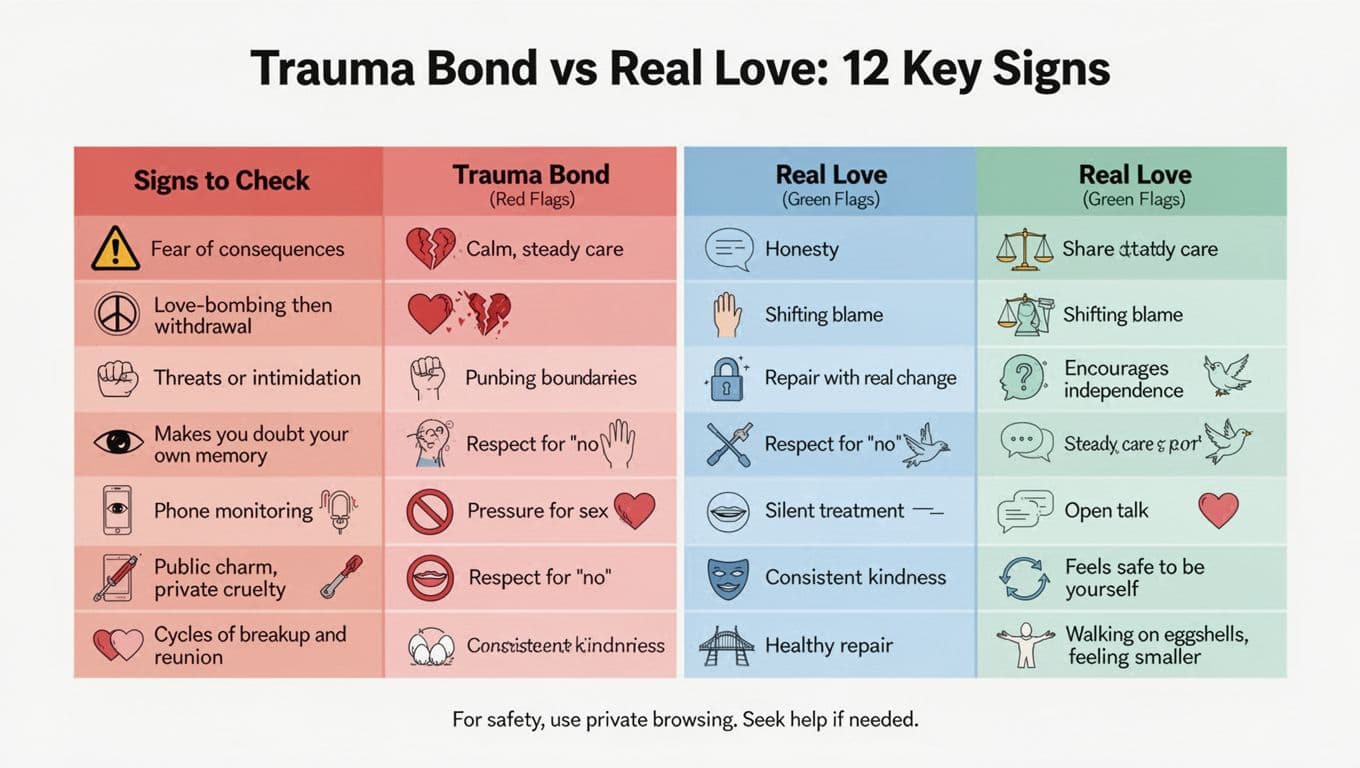
Printable table checklist (copy, save, or screenshot)
Use this table like a mirror. If the left column fits, it can point to an abusive dynamic. If the right column fits, it points more toward real love and emotional safety.
| Sign to check | More like a trauma bond (red flags) | More like real love (green flags) |
|---|---|---|
| 1) Fear of consequences | You watch what you say to avoid a blowup. | You feel mostly calm and safe. |
| 2) Love-bombing then withdrawal | Big praise, gifts, or intense closeness, then cold distance. | Care stays steady, even after stress. |
| 3) Threats or intimidation | They scare you with yelling, slamming things, or threats. | Disagreements stay respectful and safe. |
| 4) Shifting blame | Everything becomes your fault, even their behavior. | Each person owns their part without excuses. |
| 5) “Mixed up” after talks (gentle gaslighting-style confusion) | You leave conflict doubting your memory or feeling “crazy.” | Problems get named clearly, without mind games. |
| 6) Punishing personal boundaries | Your “no” leads to guilt, anger, or payback. | Your “no” gets respected, even if they’re disappointed. |
| 7) Phone monitoring | They demand passwords, check your phone, or track you. | Privacy is normal, trust isn’t forced. |
| 8) Forced sex or pressure | You feel pushed, guilted, or worn down for sex. | Consent matters, “not tonight” is safe. |
| 9) Silent treatment | They go cold to punish you or control you. | Space is discussed, then you reconnect with care. |
| 10) Public charm, private cruelty | Others see charm, you see insults or cruelty at home. | Kindness matches in public and private. |
| 11) Cycles of breakup and reunion | Breakups happen often, then intense reunions pull you back. | Conflict doesn’t threaten the relationship’s basics. |
| 12) Walking on eggshells | You scan mood and tone, and you feel on alert. | You can relax and be yourself most days. |
| 13) Feeling smaller over time | You shrink, self-silence, or lose your spark. | You grow, you feel more confident and alive. |
| 14) Shared power | One person makes the rules, the other adapts. | Decisions are shared, both voices matter. |
| 15) Repair with change | Apologies repeat, but the same harm returns. | They repair, then you see real change over time. |
If several red flags show up, it doesn’t mean you “failed.” It means your nervous system learned to survive. This kind of clarity is often the first real step in recovery and relationship healing, especially in cases of narcissistic abuse where traits like control, image management, and lack of empathy are part of the pattern.
Safety note: If you think your phone is monitored, use a safer device or private browsing to look up support.
How to use the checklist without second-guessing yourself
The hardest part is the mental tug-of-war, similar to Stockholm Syndrome in a trauma bond. One day you feel clear, the next day you remember the sweet moment and doubt everything. These tips can keep you grounded without pushing you into risky moves.
- Focus on patterns over promises. The highs from intermittent positive reinforcement feel addictive, but patterns predict your future. Write down what happens after the promise.
- Use a two-week log. For 14 days, jot quick notes: what happened, what you felt, and what changed (if anything). Keep it short so you’ll actually do it.
- Ask, “What happens when I say no?” You don’t need a big confrontation. Just notice how they respond to normal limits, like needing sleep, time alone, or a slower pace.
- Check for consistency across settings. Do they treat you well only in public? Do the rules change behind closed doors?
- Notice your body signals. Tight chest, dread before they come home, nausea after a text, or sudden relief after fear can be signs of an abusive cycle.
- Trust facts, not fog. When you start to spiral, return to what you can prove: texts, dates, repeated behaviors, and your own notes. This builds the foundation for true love.
If you can, share this checklist with a therapist or a trusted person who won’t pressure you. You deserve a steady outside voice. For one small, practical way to rebuild self-trust after control, this guide on rebuilding decision trust after control can help.
If you want confidential support and safety planning, The Hotline’s trauma bond resource is a solid place to start. If you’d like more plain-language signs and examples, this Psychology Today guide to trauma bonding cycles can also help you put words to what you’re living.
Five gentle questions to help you reflect without blaming yourself
When you’re in a confusing relationship, your mind can turn into a courtroom. You replay every word, then ask, “What did I do wrong?” That’s a common effect of emotional abuse and relationship abuse, and it can also show up in relationships touched by narcissism traits like control, punishment, or constant blame-shifting. Influences from different attachment styles can shape how people behave in these dynamics, making it harder to see patterns clearly.
These questions are meant to be softer than a “gotcha” checklist. Think of them like holding up a flashlight, not a spotlight. You’re not trying to prove anything, you’re trying to see what’s real, especially if a trauma bond has you doubting yourself.
The 5-question self-check
Answer these based on what happens most of the time, not on the best day, not after the sweetest apology. If you want to make it “printable,” copy the questions into your notes app and write one honest line under each.
- Do I feel safe to express my feelings? When I’m hurt, can I say it plainly? Or do I edit myself to avoid sarcasm, anger, coldness, or payback?
- What happens after conflict, really? Do we come back with calmer voices and real changes? Or does it turn into blame, denial, emotional manipulation, or a “you made me do it” story?
- Are my boundaries respected without punishment? If I say “no,” ask for space, or slow things down, do they accept it? Or do I get guilt, threats, silent treatment, or pressure until I give in?
- Is my world shrinking? Am I seeing friends less, explaining things away, or hiding parts of my life to keep the peace? Do I feel like I’m living inside smaller and smaller rules, perhaps drifting into codependency?
- Do I feel more peace or more anxiety over time? Step back and look at the trend line. Am I more grounded and confident than I was a year ago, or more tense and on-edge?
A quick way to reality-check your answers is to picture a friend in your exact situation. Would you tell them, “This is fine, just try harder,” or would you tell them they deserve a healthy relationship with more care?
Safety note: If someone checks your phone or computer, consider using private browsing or a safer device to take notes or look up resources.
If the answers are painful, what that might mean
Painful answers do not mean you’re dramatic. They also don’t mean you “picked wrong” and should feel ashamed. They usually mean something important: your needs are not being met, and your body is reacting the way bodies react when love feels unsafe.
In some relationships, those answers point to a trauma bond, where intense closeness follows fear or harm. The relief after a blowup can feel like love, even when it’s really your nervous system finally exhaling. In other cases, the pattern points to ongoing relationship abuse (including emotional abuse) where your feelings get punished, your boundaries get tested, and your life slowly narrows.
Sometimes people get stuck because they keep waiting for the “good version” of their partner. That hope can be powerful, especially when promises are big and your heart still wants true love to make it work. Still, the most honest question is simple: Does this relationship make your life bigger or smaller?
Clarity can hurt, but it also gives you your choices back.
No matter what you decide next, autonomy matters. You don’t have to confront them today. You don’t have to label them a narcissist to take your pain seriously. You’re allowed to gather information, talk to a therapist or advocate, and make a plan that fits your safety and finances.
If you want a deeper, structured set of reflection prompts to bring to journaling or therapy, you may find therapy questions for self-awareness and healing helpful.
Support can also make the fog lift faster. Many people notice that recovery and relationship healing start the moment they stop arguing with their own instincts. If self-blame is loud right now, this guide on retraining your inner critic after abuse can help you practice a steadier inner voice while you figure out your next steps.
If you’re worried your situation could escalate, consider reaching out for confidential help and safety planning. You deserve support that doesn’t pressure you, and doesn’t judge you.
What to do next, practical steps for boundaries, support, and recovery
When you’re untangling a trauma bond, it helps to think in three lanes: boundaries, support, and safety. You don’t have to make a huge announcement to start to break free and get your life back. In fact, small steps often work better, because they’re easier to repeat when emotions run high.
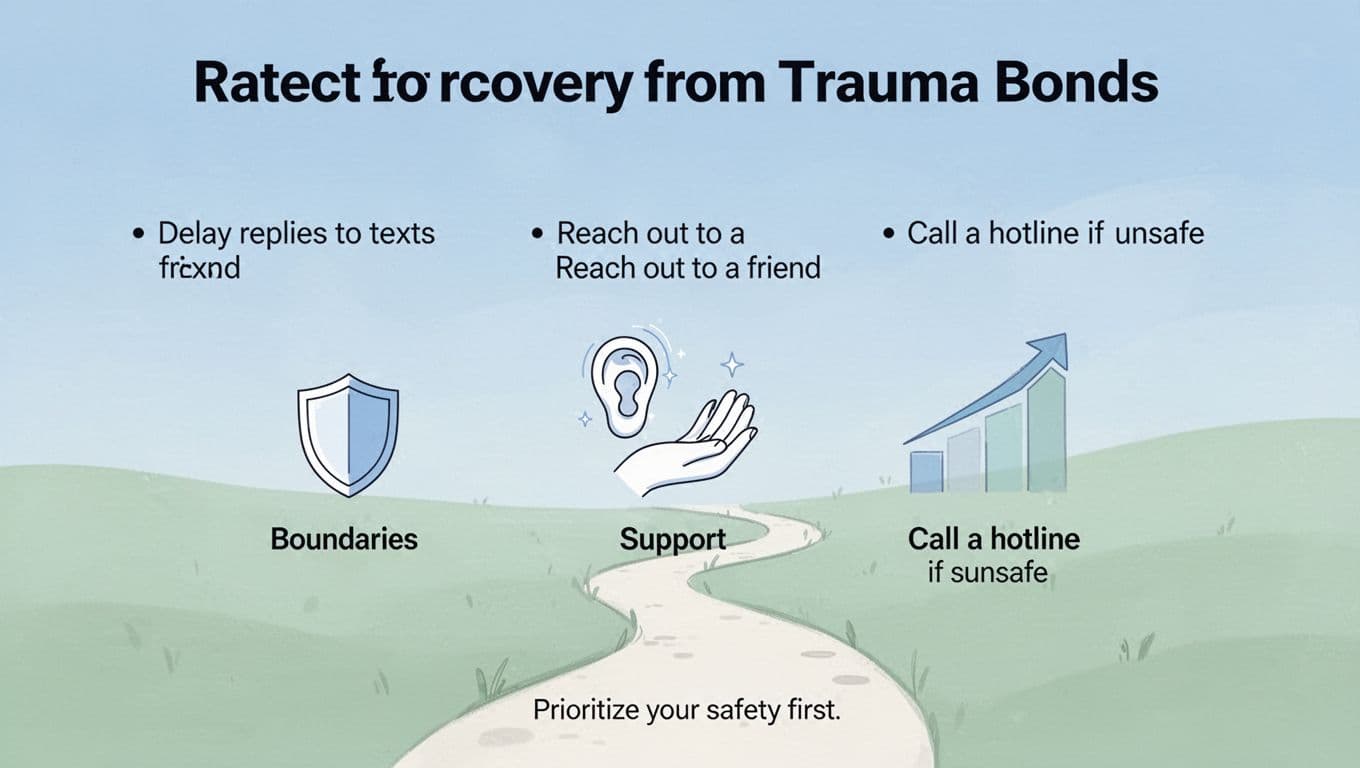
Think of recovery like physical therapy after an injury. You do small, steady moves that rebuild strength. If you’ve lived through emotional abuse or relationship abuse, your nervous system may trigger a fight-or-flight response to change like danger, even when the change is good. That’s normal. The goal is not perfection, it’s momentum.
A boundary isn’t a speech. It’s a limit you can keep, even if they dislike it.
Small boundaries you can start this week (that do not require a big confrontation)
If confrontation feels risky, start with personal boundaries that are quiet and practical. These are not “punishments.” They are basic self-protection that promotes mutual respect, especially when narcissism traits show up as control, entitlement, or payback.
Here are small boundaries many people can try without a big showdown:
- Delay replies on purpose. Wait 20 to 60 minutes before responding, so you stop living on their timer.
- Use one calm line to pause conflict. Try: “I’ll talk when we’re calm,” then stop arguing.
- Keep plans with friends or family. Don’t cancel to manage their mood. Show yourself you still exist.
- Keep your own money when you can. If it’s safe and legal, separate spending money or open a personal account.
- Turn off location sharing. You can say it’s for privacy or battery, but you don’t owe a debate.
- Don’t share passwords. Privacy is not secrecy, it’s a normal adult right.
- Leave the room when yelling starts. “I’m taking a break,” then go to a safer space.
- Sleep separately if needed. Rest is a safety tool, not a relationship failure.
A simple “printable” reminder can help when you freeze. Save this somewhere private:
- My time matters.
- My privacy is normal.
- My no is allowed.
- I can pause a conversation.
- I don’t have to prove my reasons.
If you notice retaliation (rage, threats, stalking, silent treatment that feels like punishment, breaking things, blocking you from leaving), treat that as a major warning sign. At that point, focus less on “better boundaries” and more on safety and support. If guilt pulls you into long explanations, this guide can help you practice firm limits without getting trapped in debates: stop overexplaining your boundaries.
Support that actually helps, friends, therapy, and advocacy
Isolation lets a trauma bond or toxic relationship thrive. Support works best when it’s steady, practical, and nonjudgmental. You don’t need ten people. You need one or two safe ones.
Who to reach out to:
- One trusted friend or family member who can keep things private and calm.
- A trauma-informed therapy provider (look for terms like trauma-focused, domestic violence-informed, EMDR, or somatic therapy).
- A domestic violence advocate (confidential, practical, and often free). Advocates can help with safety planning, housing options, legal referrals, and emotional support without pushing you to leave before you’re ready.
What to say (copy and paste):
- “I’m going through something confusing. I don’t need advice yet, I need someone to listen.”
- “I might be in an emotionally abusive situation. Can I check in with you once a week?”
- “If I start doubting myself, can you remind me what I told you happened?”
- “If I need help fast, could I call you and just say, ‘I need you’?”
If you’re worried you’ll get talked out of your reality, ask for specific support: a ride, a place to store documents, company while you call a hotline, help finding a therapist, or someone to sit with you while you make a plan. Those “boring” supports are often what make relationship healing possible, because your body starts to feel less alone.
For friends and family reading this: the best help is usually quiet and practical, especially to support a path toward a healthy relationship.
- Listen, don’t push. Pressure can increase danger and shame.
- Believe patterns, not honeymoon phase charm. Many abusive people look great to outsiders.
- Offer options, not orders. “Do you want me to come over?” beats “You have to leave.”
- Stay consistent. One check-in text each week can support recovery more than one intense talk.
If you’re trying to name what you’ve lived through without getting stuck in labels, this overview may help: narcissistic abuse patterns explained.
Safety planning basics and red flags that mean you need immediate help
If you feel unsafe, trust that feeling. Many people minimize danger because it’s easier than facing it. Still, certain red flags mean you need immediate help and a safety plan.
Seek urgent help if any of these are happening:
- Threats to hurt you, themselves, your kids, or others
- Stalking or showing up at your work, home, or friends’ places
- Choking or strangulation (even “once,” even “lightly”)
- Weapon threats or access to weapons used to intimidate
- Forced sex or sexual coercion
- Escalating violence (more frequent, more intense, more scary)
- Suicide threats used to control you (“If you leave, I’ll do it”)
- Pregnancy-related control (sabotaging birth control, threats, isolation)
- Blocking exits or physically preventing you from leaving a room
- Tech monitoring (spyware, constant location tracking, reading messages)
- Harm to pets or threats to harm pets
If you are in immediate danger, call your local emergency number right now.
Safety planning basics can be simple: keep important documents accessible, know where you could go in a hurry, and choose a code word with a friend. If you share a home, consider where you can move during conflict (near an exit, away from kitchens and weapons).
Safer digital steps (basic only): If you worry someone checks your phone, use a trusted device when possible. Use private browsing, and consider clearing your browser history only if it won’t increase risk. Avoid making sudden setting changes that could trigger retaliation.
If reducing contact is part of staying safe, you can compare options like no-contact, low-contact, and gray rock here: choose safest contact after abuse.
Reputable resources to keep handy
Save a few trustworthy resources now, so you’re not searching in a panic later. If you live outside the US or UK, look for local domestic violence services and national hotlines in your country.
- National Domestic Violence Hotline (US) Confidential support, safety planning, and ways to get help.
- Loveisrespect Support and education for dating abuse and healthy relationship skills.
- RAINN Sexual violence support and information, including confidential help options.
- APA psychologist locator Helps you find a licensed psychologist in the US.
- NHS domestic violence help (UK) UK guidance on recognizing abuse and finding support.
- Psychology Today therapist directory A large directory to search for therapists by location and specialty.
Conclusion
A trauma bond runs on fear, cycles, and relief after pain. Real love runs on steadiness, respect, and repair that lasts. If you’ve lived with emotional abuse, relationship abuse, or narcissism patterns, the calm can feel strange at first, but safety is the point of pursuing a healthy relationship.
Before you make any big move, use what you already have here to break free:
- Re-check the table for what happens most days, not after apologies.
- Answer the 5 questions again, and write one honest line each.
- Take one next step today, text a safe person, book a therapy consult, or make a simple safety plan.
For extra support, consider:
- https://www.thehotline.org/
- https://www.apa.org/topics/violence/intimate-partner-violence
- https://www.nhs.uk/live-well/getting-help-for-domestic-violence/
- https://www.psychologytoday.com/us/therapists
If you worry someone monitors your device, use private browsing or a safer device. This post is educational, not professional advice. If you’re in immediate danger, call your local emergency number now.
Thank you for reading and for taking yourself seriously, recovery and relationship healing often start with one quiet decision: you’re allowed to trust what you feel, and you’re allowed to choose an authentic connection that protects you.